In the spirit of the World Cup: Over 600 children from 21 cities participate in the “Fußball trifft Kultur” final tournament

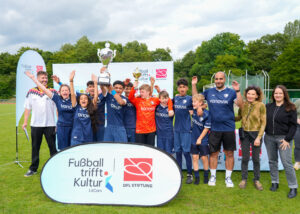
Frankfurt, June 15, 2026: While the soccer world’s attention is focused on the World Cup in North and South America, around 600 children experienced their very own highlight at the grand finale tournament of the “Fußball trifft Kultur” (FtK) educational program. Participants from 21 cities traveled to the Riedstadion in Frankfurt-Enkheim to compete for the coveted trophies in the U10, U12, and U14 age groups—as part of this year’s FtK World Cup 26 Challenge, in which the children engaged with the 2026 FIFA World Cup in a playful and creative way throughout the school year.

The tournament was made possible by funding from the DFL Foundation. This year, Anton Schumacher, educational director of Eintracht Frankfurt’s youth academy, served as tournament director. Colin Mahnke, stadium announcer for SV Darmstadt 98, hosted the event.

Educational program combines soccer with language and culture

The 16th “Fußball trifft Kultur” (FtK) final tournament marks the culmination of an inclusive educational program that reaches approximately 750 children nationwide. At 33 locations, “Fußball trifft Kultur” combines soccer training with language and skills development twice a week. In cooperation with professional clubs in the Bundesliga and 2. Bundesliga, additional learning and experiential opportunities are created—ranging from stadium visits to children’s press conferences.

WM26 Challenge: The World Cup as a Learning Opportunity

This year, the World Cup served as an additional learning and motivational opportunity. As part of the FtK-WM26 Challenge, the children explored topics related to the tournament—from participating nations to values such as diversity, fair play, and respect, all the way to their own creative projects. The glass trophies for the winners of the FtK-WM26 Challenge were awarded on-site in Frankfurt during the tournament. The winners were also delighted to receive new soccer balls.

Tournament Winners, Fair Play Awards, and All-Star Teams—This Year’s Winners*

The end-of-school-year tournament exemplifies the program’s inclusive approach: Through the unifying power of soccer, children from a wide variety of backgrounds come together, compete for their partner clubs, and showcase the skills they’ve developed over the year—thereby bringing a sense of unity, fair play, and team spirit to life. The excitement was particularly high this year at these three schools—they won the tournament and, with it, the coveted challenge cup:

U10: An der Glinder Au Elementary School in Hamburg, partner club FC St. Pauli

U12: IGS Mainz-Bretzenheim from Mainz, partner club of 1. FSV Mainz 05

U14: Werner-von-Siemens School in Bochum, partner club VfL Bochum 1848

As is tradition, the fairest teams in the tournament were also awarded the Fair Play Trophy. This year, the award went to the Michael-Ende-Schule from Frankfurt (U10), the Gesamtschule Essen Nord from Essen (U12), and the Pestalozzi-Mittelschule from Würzburg (U14). Another honor was presented for only the second time: In each age group, children were selected for the All-Star Team. The evaluation took into account not only their soccer performance but also their conduct on and off the field.

Dr. Nadine Seddig, Head of Programs and Grant Management at the DFL Foundation—which has been supporting “Fußball trifft Kultur” as a nationwide partner since 2012—is convinced of the program’s approach: “Recent studies show that more and more children in Germany are leaving elementary school without adequate reading and writing skills. ‘Fußball trifft Kultur’ addresses this issue head-on and specifically targets educationally disadvantaged children. We have supported the program for many years because soccer creates low-barrier access, motivates participants, and, when combined with language and cultural support, has a lasting impact. The final tournament was once again a special highlight this year, with the children participating with great enthusiasm, team spirit, and a true sense of fair play.”

Karin Plötz, director of LitCam gGmbH, which has been implementing the inclusive education program since 2007, also offered a positive assessment: “The final tournament is and remains the highlight of the FtK program year for the children. The motivation to play for the FtK Cup on this day while wearing the jersey of their favorite club makes it easier for the children to attend the extra classes and soccer practice twice a week. In the truest sense of the word, they learn not only German but also respect, fairness, and team spirit—skills that will empower them for their future.”
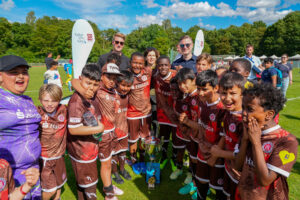
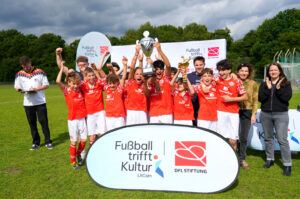
Copyright: DFL Foundation/Witters


The “Fußball trifft Kultur” World Cup 26 Challenge

The “Fußball trifft Kultur” World Cup 26 Challenge

The “Fußball trifft Kultur Final Tournament” will take place on June 13 and 14, 2026 in Frankfurt in the run-up to the 2026 FIFA World Cup. The host countries for the games are the USA, Mexico and Canada. In addition to their respective clubs, the program groups of the respective FtK locations will also present a country drawn by lot at the final tournament this year. This can take the form of a run-in with the corresponding country flag, for example.

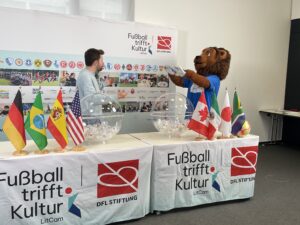
The draw:

Together with mascot Litti, presenter Tim Gailus and LitCam Director Karin Plötz, a draw was held in the run-up to the final “Fußball trifft Kultur” tournament. Each program location was assigned one of the countries qualified for the World Cup. The program groups then received the corresponding country flags by post so that they could start their preparations.

Photo credit: Patrick Klaus

The task:

The FtK program groups have until May 6 to deal with the content of their country and develop a creative presentation. There are no limits to the children’s creativity. The creative elaboration should then be sent to LitCam in the form of a photo of what has been created and, if applicable, a short video (maximum 1:00 minute long) in which the children present their ideas. The posts submitted will then be judged by a jury according to the criteria of creativity, content and presentation.

The jury:

The jury is divided into two groups. The first group evaluates the work of the U10 FtK groups and the second group evaluates the work of the U14 FtK groups. The following people are part of the jury:

Jury for the U10 submissions

  • Tim Gailus, KIKA presenter
  • Matthias Mühlen, VFL Bochum Management Board
  • Phillipp Mwene, professional footballer Mainz 05, Austrian national player and Laureus Sport for Good ambassador
  • Julia Schilling, Co-Managing Director Laureus Sport for Good Germany & Austria
  • Karin Plötz, Director LitCam gGmbH

Jury for the U14 submissions

  • Franziska Fey, Chairwoman of the Board of the DFL Foundation
  • Brigitte Hirschler, Head of the Foundation and Competitions Department, Hessian Ministry of Education and Cultural Affairs
  • Jonas Kozinowski, Managing Director of Feinherb Medien and soccer book author
  • Anton Schumacher, Head of Pedagogy and Sports Boarding School (NLZ) Eintracht Frankfurt
  • Elvis Rexhbecaj, professional soccer player FC Augsburg, national player Kosovo
  • Karin Plötz, Director LitCam gGmbH

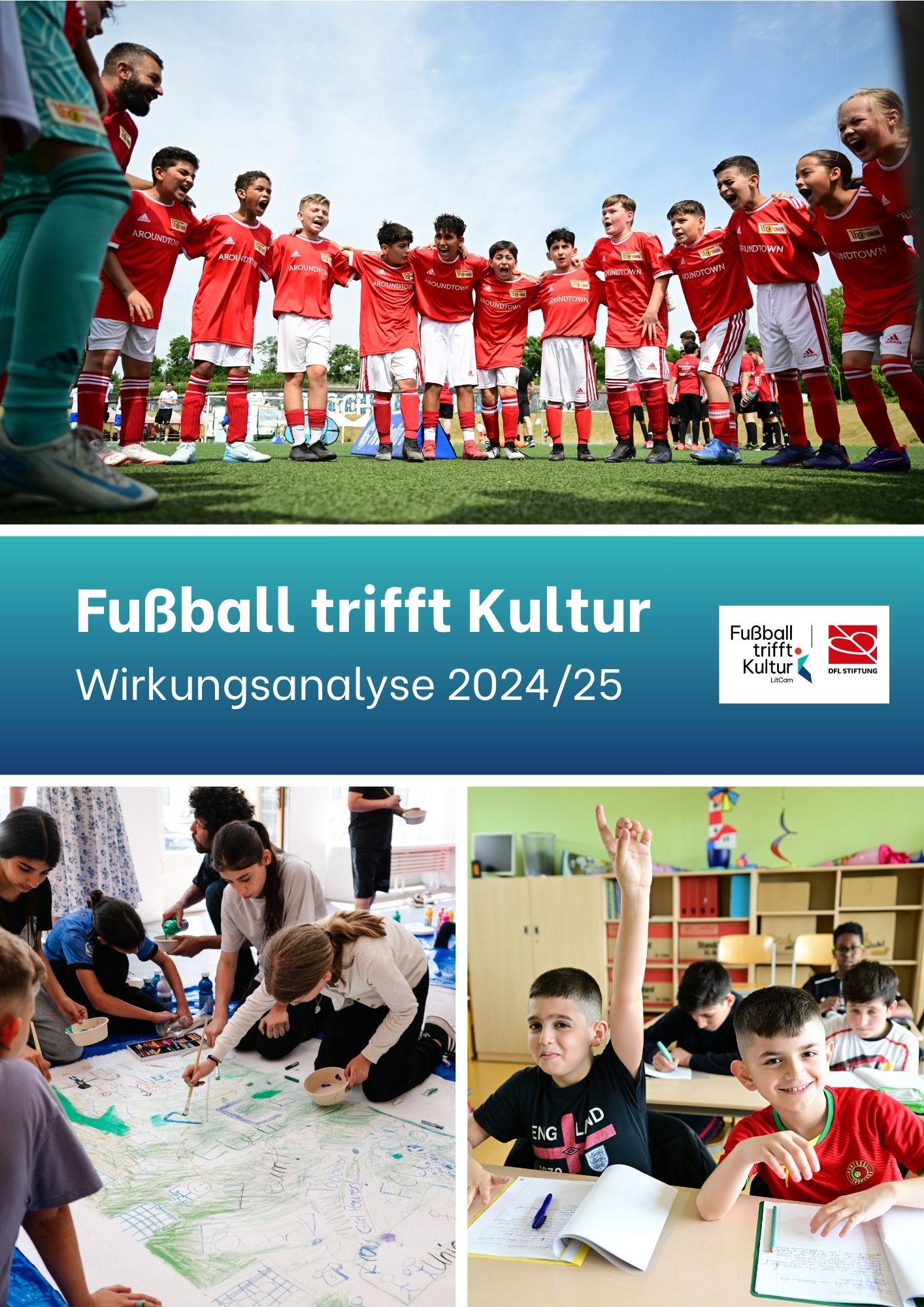
“Fußball trifft Kultur”: Impact analysis 2024/25 is here!

Our impact analysis for “Fußball trifft Kultur” in the 2024/25 school year is here! We published our report today, taking a detailed look at the results of the past FtK year. For the first time, the so-called “success stories” are also part of the report.

To create our impact analysis, we rely on our classic, two-pronged survey procedure: Firstly, the survey of the primary target group, the children. The children are surveyed at the end of the school year and can report on their learning progress as well as their motivation and feelings about “FtK”. And secondly, the views of our multipliers, our honorary staff, are also included. Our trainers and teachers submit a final report at the end of the school year, which allows us to better understand the developments in the group. For the first time, the trainers and teachers can also write down their “success stories”: In doing so, they give an anecdotal account of how individual participants have developed at “FtK” and how their behavior and skills have changed. The aim of the “success stories” is to make the results and impact of “Fußball trifft Kultur” more tangible.

In addition to the final reports, our honorary staff also document their content and performance in monthly reports. The monthly reports can be used to determine the exact number of hours and the respective absences. The utilization of the units is also documented, i.e. how many of the registered children are actually present.

The results of the 2024/25 impact analysis are impressive: 98% of all children say they have fun at “Fußball trifft Kultur”. Soccer training traditionally performs slightly better, but the majority of children also enjoy the lessons – which is very positive, especially considering the target group. The results for social skills are also excellent. 93% of the children say they treat each other with respect. It is clear from the reports of the trainers and teachers that this was often a development process, as there were often difficulties in dealing with each other at the beginning of the school year.

Further survey results, learning outcomes and an insight into some success stories can be found in our impact analysis, which is available to download HERE.